 Jupiterexchange
 swaps can fail when slippage tolerance is too tight
last updated
Jupiterexchange can reject an exact-input Solana swap when execution would produce fewer tokens than the transaction’s minimum output amount. Tight tolerance places that minimum close to the quote, so market movement can trigger a failure. A wider setting lowers the protected minimum and can accept a worse price. Automatic estimation offers another approach. The useful adjustment depends on whether the failure concerns price movement, transaction landing, or a different execution requirement.
The minimum output sets a rejection boundary
For an exact-input swap, slippage tolerance determines the minimum acceptable output, while the quote expresses expected output under the market conditions available when the order was created. The input amount defines the requested sale. The output bound limits how far the exchange can move against that quote. Tightening tolerance brings the bound closer to the estimated amount; widening tolerance creates more room for adverse movement. In Swap V2 responses, otherAmountThreshold identifies the minimum output after applying slippage. That field records the execution requirement. It does not predict the final receipt.
Permission to accept a worse output does not mean that execution must use the entire tolerance. The actual fill follows the applicable market and transaction conditions. The estimate, protected minimum, and final token receipt therefore describe different quantities. Fee deductions also matter when comparing route output with the amount reflected in a wallet.
A rejected output bound can be working exactly as intended when the available execution price has deteriorated.
Price impact is already reflected in the quote
Price impact describes the effect of trade size relative to available liquidity, whereas slippage describes the difference between the quoted result and the result at execution. A pool with shallow liquidity can offer a poor price before any delay occurs. Increasing tolerance does not improve its reserves or reverse the effect of the requested trade. It changes which output the transaction will accept. A fresh quote can therefore show substantial price impact even when subsequent execution stays close to that quote.
On Spot, the displayed price impact includes Ultra fees and applicable gasless cost recovery alongside the trading effect. Comparing the expected output, impact estimate, and fee breakdown helps distinguish an expensive starting quote from deterioration after quoting.
Fixed tolerance and RTSE serve different constraints
Fixed slippage maintains a chosen percentage bound for an individual quote, while the Real-Time Slippage Estimator (RTSE) calculates a tolerance using observed market behavior and failure rates. Fixed settings suit a defined acceptance limit. Automatic estimation responds to conditions that can make a single preset unsuitable across swaps. RTSE uses token characteristics, historical and recent slippage data, and monitoring of failed transactions. Its purpose is to balance execution success with protection against adverse output changes.
In Swap V2, RTSE estimates tolerance when the order is created. The returned transaction contains that estimate. RTSE does not continuously revise a signed transaction as prices move. A later order can carry a different estimate because market conditions and monitoring inputs have changed. Neither a fixed setting nor an estimated setting preserves the absolute price of an earlier quote when a new quote uses a different market state.
Spot modes and API paths expose different controls
Jupiter Spot uses Ultra Mode for automatic slippage settings and offers Manual Mode for a fixed tolerance that the trader selects. Manual Mode also exposes transaction-fee and routing controls. In Spot Manual Mode, swaps have no refunds or support and do not count toward Jupiter incentive campaigns.
Ultra includes private submission designed to reduce exposure to maximal extractable value (MEV), including sandwich attacks. Manual Mode does not carry Ultra’s built-in MEV protection. A wider tolerance can permit more adverse execution in an exposed submission path. Protection that reduces this risk does not eliminate it.
Swap V2 gives integrations separate Meta-Aggregator and Router paths. The Meta-Aggregator combines quotes and transaction assembly with managed landing. RTSE applies automatically unless the request supplies a fixed slippageBps value. The response records the settings for that particular order.
The Router path supplies raw instructions for custom transaction construction and uses Metis onchain routing. Its documented default is 50 basis points, or 0.5%, for fixed slippage. Passing slippageBps=rtse opts into estimation. This default belongs to that API path, not every Jupiter interface.
A wallet integration can choose a numeric override even when its underlying API supports automatic estimation. The effective tolerance follows the parameters that the integration passes. Likewise, an API’s order-mode label does not identify the router that actually supplied its quote. On eligible pairs, JupiterZ request-for-quote (RFQ) fills use a firm market-maker price with zero slippage.
Trade size changes the demand on liquidity
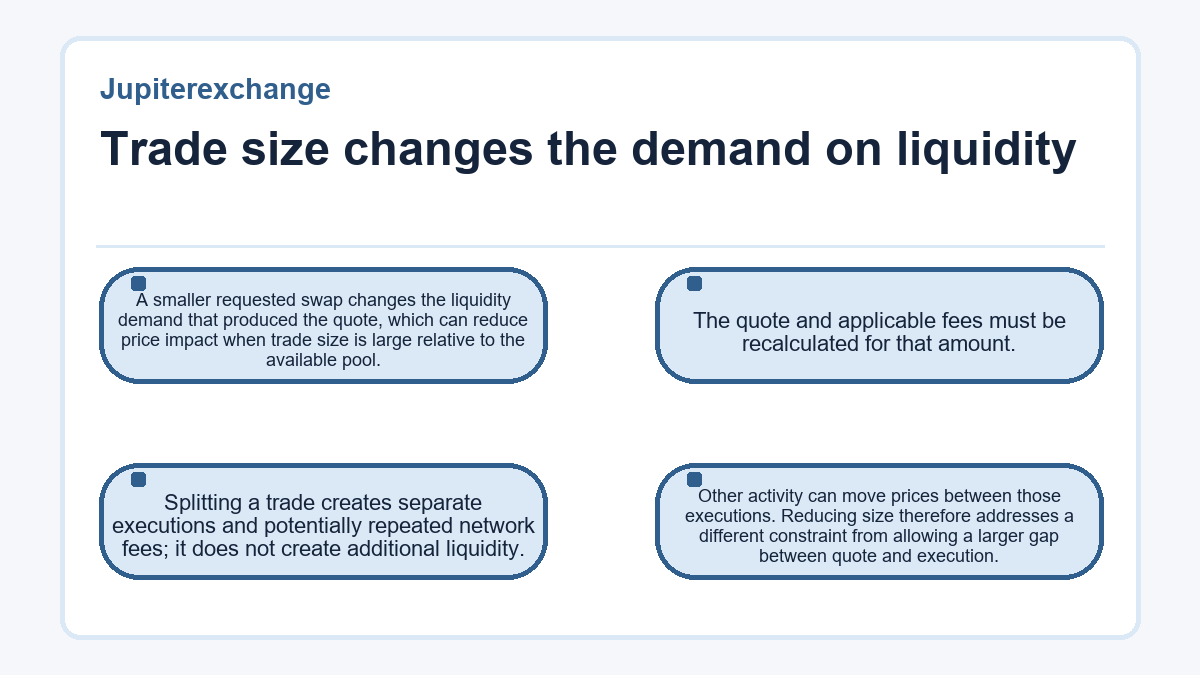
A smaller requested swap changes the liquidity demand that produced the quote, which can reduce price impact when trade size is large relative to the available pool. The quote and applicable fees must be recalculated for that amount. Splitting a trade creates separate executions and potentially repeated network fees; it does not create additional liquidity. Other activity can move prices between those executions. Reducing size therefore addresses a different constraint from allowing a larger gap between quote and execution.
Quote freshness and transaction validity remain separate
A current swap quote reflects a more recent market state, which can reduce the mismatch caused by waiting between quotation and submission. Refreshing it changes the reference output. Keeping the same percentage tolerance then applies that percentage to the new quote, not the earlier amount. If the market has moved adversely, the refreshed estimate can already be lower before any additional slippage occurs. Accepting that estimate is a separate price decision from widening its tolerance.
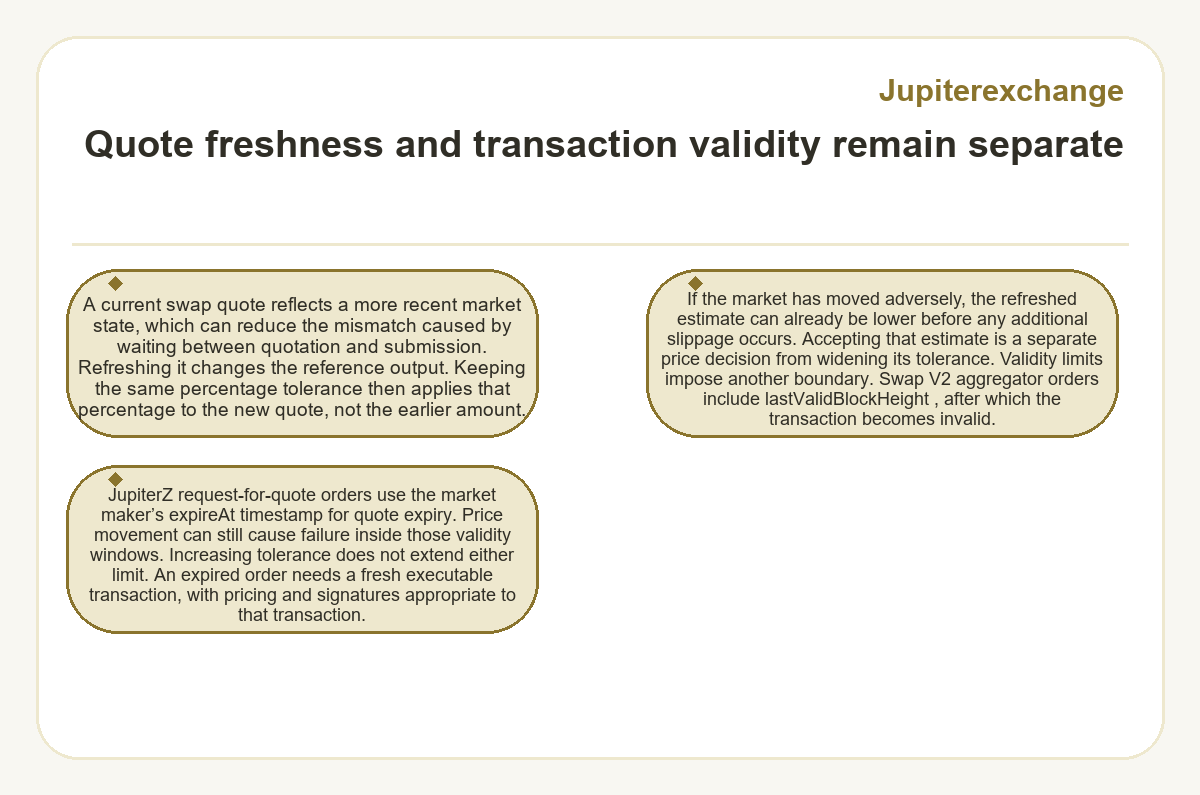
Validity limits impose another boundary. Swap V2 aggregator orders include lastValidBlockHeight, after which the transaction becomes invalid. JupiterZ request-for-quote orders use the market maker’s expireAt timestamp for quote expiry. Price movement can still cause failure inside those validity windows. Increasing tolerance does not extend either limit. An expired order needs a fresh executable transaction, with pricing and signatures appropriate to that transaction.
Priority fees affect landing rather than the output bound
Solana priority fees influence transaction scheduling, while slippage tolerance governs acceptable output, so the two settings address different reasons that a swap can fail or arrive late. Better landing can shorten the interval in which market conditions change. It cannot authorize output below the transaction’s bound. Conversely, a generous output tolerance cannot supply an invalid signature or make an expired transaction valid.
Ultra manages landing and fee settings automatically. Manual settings and custom builds expose different responsibilities for submission and compute resources. A transaction that requests insufficient compute can fail independently of its slippage setting. Increasing a priority fee also introduces a cost that differs from the price deterioration permitted by wider tolerance.
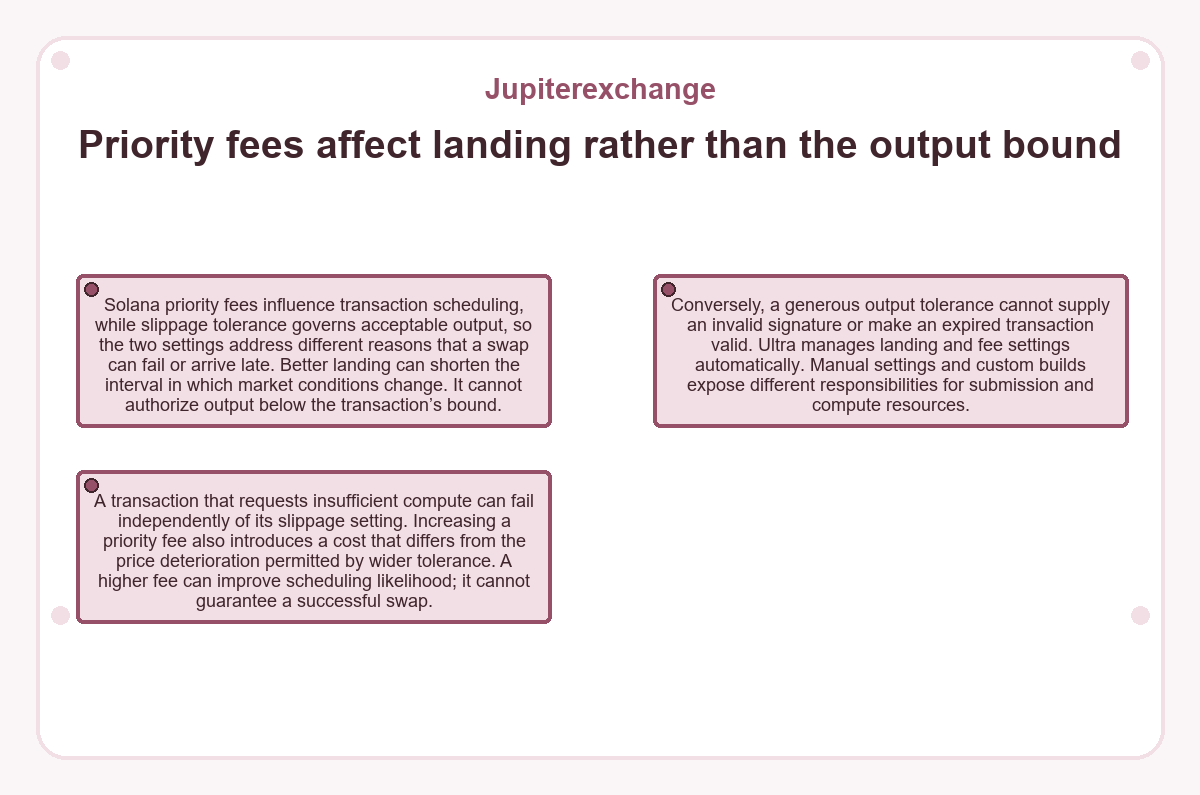
A higher fee can improve scheduling likelihood; it cannot guarantee a successful swap.
Non-price errors require a different correction
A swap error concerning funds, token accounts, or transaction construction identifies an execution requirement that a higher slippage setting cannot satisfy. The required balance can include the input tokens and, depending on the fee payer, network fees or account-creation costs. An invalid token account needs an account correction. A transaction with invalid message data or a missing signature required at submission needs correction. These failures can occur even when the quoted price remains acceptable.
Liquidity availability is another distinct condition. Without an executable market, additional tolerance cannot produce a trade. A route-pricing refresh error can also block the swap because the application lacks current pricing. This differs from an onchain failure caused by output falling below the transaction’s minimum. Error interpretation should retain the emitting program or API context: a router’s service error and an onchain swap-program error do not necessarily share the same numbering or meaning.
Failed execution can still incur network fees
A Solana transaction that fails during onchain execution still incurs its transaction fee. The swap’s instruction changes revert, while the fee payer bears the network charge. That payer can differ from the trader on supported sponsored or market-maker-funded paths. A preflight rejection before onchain processing is a different state; an interface error alone does not establish a charged transaction.
Successful-swap accounting also separates route output from wallet receipt. In Swap V2, outputAmountResult describes the route’s output before any fee collected in the output token. totalOutputAmount describes the final output reflected in the wallet after that fee. This difference can explain a smaller receipt without treating every deduction as market slippage. The fee token determines which side of the exchange carries that deduction.
Repeated submitted failures can accumulate network costs even while the output protection consistently rejects unfavorable execution.
Legacy Dynamic Slippage used an older integration
Dynamic Slippage was a simulation-based estimator used in the older Metis Swap API. Jupiter discontinued its development, and that API is no longer actively maintained. Swap V2 uses RTSE for automatic estimation. The mechanisms have different integration parameters, so an older dynamicSlippage recipe does not configure Swap V2. The API version determines which settings apply; an old example does not establish the behavior of a current integration.
The reported failure determines the useful adjustment
Choosing between a fixed limit, automatic estimation, and another correction starts with the condition that prevented execution. A change helps only while it addresses that condition and leaves an acceptable output requirement.
- If slippage exceeded the tolerance, compare the protected minimum under a fixed setting with automatic estimation; widening the limit permits fewer output tokens.
- If the estimate already shows substantial price impact, compare a smaller requested amount before attributing the entire shortfall to slippage.
- If submission or scheduling is the problem, examine the applicable landing and fee settings; changing the output bound does not correct those requirements.
- If the order expired or its transaction is invalid, obtain current transaction data instead of broadening its price tolerance.
- If funds, token accounts, or liquidity are missing, correct that specific requirement before considering another slippage setting.
A change that makes execution possible can also make its price less acceptable. The minimum output of the resulting quote determines the loss of price protection that accompanies a wider setting.
Everyday questions about Jupiterexchange
Will custom slippage disable market-maker quotes in Swap V2?
A fixed slippageBps override alone does not disable JupiterZ market-maker quotes on Swap V2’s Meta-Aggregator path. Other parameters can restrict routing. The separate Router path remains Metis-only whether its tolerance is fixed or estimated through RTSE.
Can the wallet estimate differ from the swap quote?
A wallet simulation can show a different amount because it evaluates the transaction against a different market state from the quote. Later onchain execution can encounter another state. The wallet’s simulated amount therefore remains an estimate, while a confirmed successful swap establishes the executed token amounts.
Does slippage protection verify that the purchased token is genuine?
Slippage protection controls acceptable execution output and does not authenticate the token that the trade buys. Solana tokens can share names or tickers, so token identity depends on the mint address. A successful swap within tolerance can still purchase an impersonating token.
What does error 6001 mean in the Jupiter Swap Program?
Error 6001 identifies SlippageToleranceExceeded in the Jupiter Swap Program. It indicates that execution breached the applicable slippage protection. The program name matters: an identical number from another program or service does not establish the same cause. A generic failure message needs its underlying error context.
Is zero slippage tolerance the same as a limit order?
Zero tolerance gives an exact-input market swap no room for adverse output movement relative to its quote. A limit order waits for a trigger condition and has separate settlement rules. Setting the market swap’s tolerance to zero does not make it wait for a target price.