 Jupiterexchange
 combines Solana swaps, lending, and perpetual trading with product-specific costs
last updated
Jupiterexchange combines Solana swap aggregation with lending markets and perpetual trading. Swap quotes can change before execution, and Lend borrowing or Perps positions can be liquidated. Aggregation searches available liquidity for a token exchange; lending supplies or borrows assets through pools. Perpetuals create leveraged price exposure, with terms that depend on the selected market. The platform also includes automated orders, prediction markets, and wallet tools. Fees follow the product, execution mode, and any conversions that the transaction requires. A swap changes token holdings, while a loan or perpetual position can continue accruing costs after entry. These differences affect how to read a quote, compare a rate, and interpret an open position.
The JLP and Beta labels identify different perpetual trading models, so their borrowing fees and funding rates require separate comparisons.
Spot exchanges tokens while Lend and Perps maintain positions
Spot trading connects available Solana liquidity for token exchanges, while Lend and Perps support positions that remain open after entry. A spot swap delivers the purchased asset. Borrowing creates debt secured by collateral, and a perpetual position tracks price exposure without purchasing the underlying asset outright. Supplying liquidity adds another relationship: lenders fund borrowers, while JLP holders back particular perpetual markets. These products share an interface, yet a swap estimate, lending yield, and trading profit describe different economic outcomes.
Spot swaps and automated orders
Jupiter Spot combines liquidity aggregation with token discovery, charts, and orders that execute immediately or follow specified conditions. Routing draws on supported liquidity sources and can split a swap across venues. The available liquidity and trade size influence the quoted output, so a displayed token price alone cannot establish an executable exchange rate.
Immediate swaps
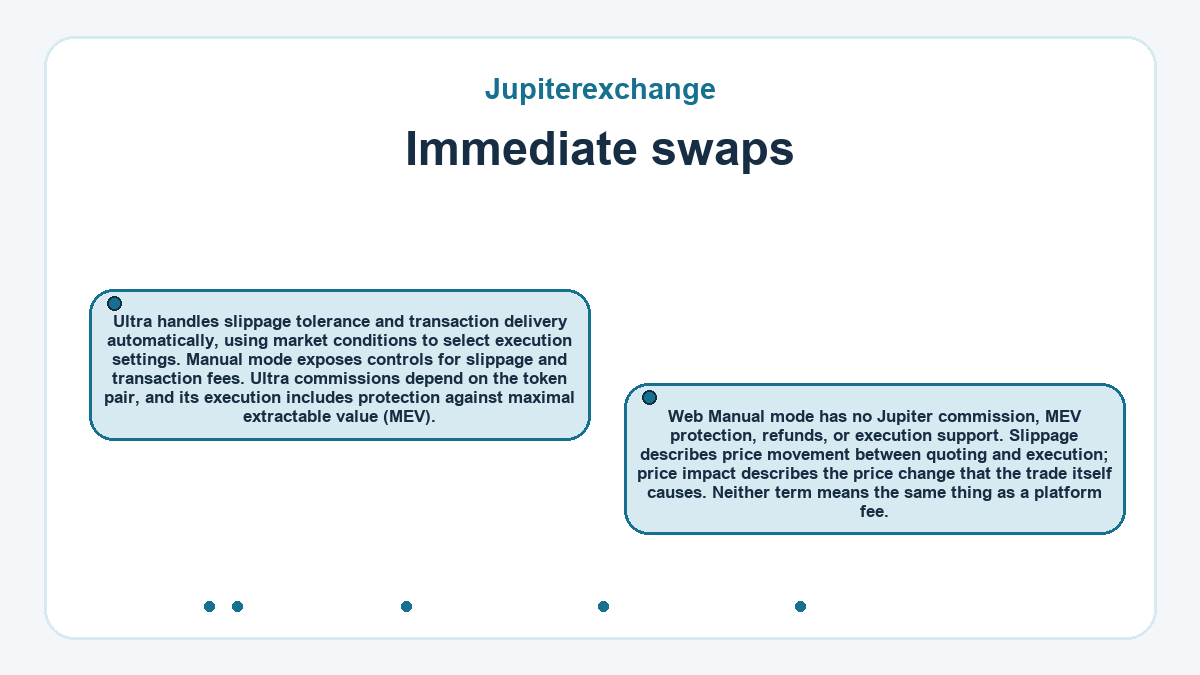
Ultra handles slippage tolerance and transaction delivery automatically, using market conditions to select execution settings. Manual mode exposes controls for slippage and transaction fees. Ultra commissions depend on the token pair, and its execution includes protection against maximal extractable value (MEV). Web Manual mode has no Jupiter commission, MEV protection, refunds, or execution support. Slippage describes price movement between quoting and execution; price impact describes the price change that the trade itself causes. Neither term means the same thing as a platform fee.
Orders with execution conditions
Limit orders respond to a price condition, and DCA orders distribute purchases over time. Their execution rules differ from an immediate swap.
Limit Order V2
On the web, Limit Order V2 uses a token’s dollar price or market capitalization as its trigger. It then attempts execution through Ultra, subject to available liquidity and slippage tolerance. Reaching the trigger does not guarantee a fixed output amount. The selling tokens remain in a program-owned vault while the order is active. The web interface no longer creates V1 orders; existing legacy orders follow their own rules.
DCA orders
DCA means dollar-cost averaging: an allocation funds smaller purchases at scheduled intervals. The web interface uses the DCA label, while Jupiter Mobile calls these Recurring orders. Web V2 orders can use an optional USD price range on a trigger token, except for stablecoin-to-stablecoin pairs. If that token’s price is outside the range, the scheduled purchase waits and retries at later intervals. Each purchase uses market conditions at execution, so a schedule cannot lock every purchase to the initial quote. The web interface no longer creates V1 orders.
Lend and Offerbook use different loan structures
Jupiter Lend connects lending pools with collateralized borrowing, while Offerbook matches fixed-term loan offers directly between borrowers and lenders.
Earn, borrow, and Multiply
Earn supplies assets to pools and receives interest from borrowing activity. Annual percentage yield, or APY, expresses an annualized return; the rate changes with pool conditions. Active incentives can contribute to the displayed APY and can end. A quoted yield therefore does not establish the return over an entire holding period.
Borrow retains exposure to deposited collateral while creating a debt in another supported asset. Loan-to-value measures debt relative to collateral value, and each vault sets its borrowing and liquidation thresholds. Falling collateral value or growing debt can move a position toward liquidation. Liquidators repay debt and receive collateral plus a penalty on the liquidated portion.
Multiply increases asset exposure through automated collateral-backed borrowing and reinvestment. Standard Multiply borrows, swaps, and reinvests collateral within one atomic transaction. Borrow interest, swap route fees, and price impact still affect the position. The amplified exposure also increases losses when the relevant prices move against it.
Smart Vaults add trading-fee income by letting the smart side of a position serve as Jupiter AMM liquidity. They are optional per position; standard Lend positions have no exposure to that AMM. Smart Earn is a separate supply-only product with no debt. Trading-fee income and borrowing costs remain separate inputs when evaluating a leveraged smart position.
The Bitwise x Ethena Market is winding down, with the Sentora Market serving as a migration destination. Positions must be unwound before the wind-down deadline to avoid accruing negative interest. That deadline has not yet been finalized.
Fixed-term credit through Offerbook
Offerbook lends and borrows USDC against supported collateral at fixed terms. Loan durations range from 1 to 30 days. Repaying early still requires the full agreed term’s interest. Collateral price changes do not trigger liquidation during the loan. After maturity, an unpaid loan allows the lender to claim its collateral. The borrower can still repay until that claim occurs. This timing-based model differs from Lend’s continuing collateral monitoring.
Perps uses JLP-backed and Beta trading models
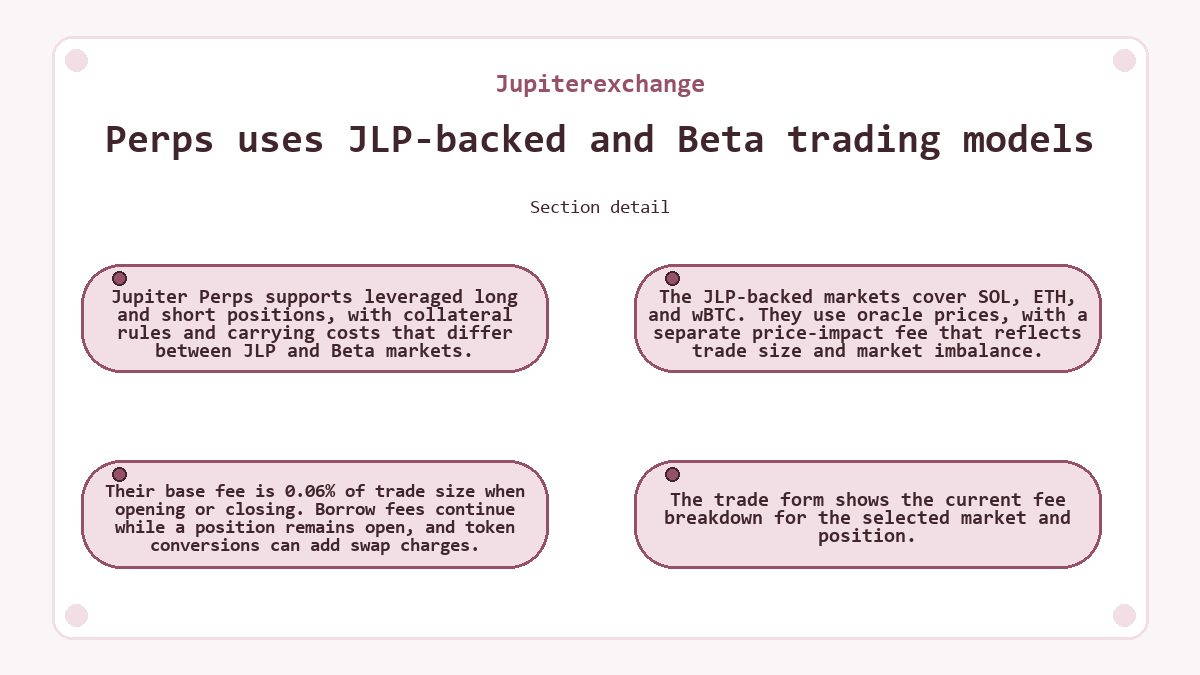
Jupiter Perps supports leveraged long and short positions, with collateral rules and carrying costs that differ between JLP and Beta markets. The JLP-backed markets cover SOL, ETH, and wBTC. They use oracle prices, with a separate price-impact fee that reflects trade size and market imbalance. Their base fee is 0.06% of trade size when opening or closing. Borrow fees continue while a position remains open, and token conversions can add swap charges. The trade form shows the current fee breakdown for the selected market and position.
JLP is a token representing a share of the pool that supplies liquidity to those markets. The JLP pool receives 75% of the fees generated by Jupiter’s JLP-backed perpetual markets. Its value also responds to the pool’s assets and trader profit or loss. Profitable traders draw value from the pool, so fee income does not make JLP capital protected. Acquiring JLP through a swap and minting it directly use different pricing and fee mechanisms.
Beta markets use GUM’s orderbook engine with USDC collateral, separate from the JLP pool. They apply maker or taker fees and funding between long and short positions, rather than JLP-market borrow fees. A positive funding rate means longs pay shorts; a negative rate reverses that direction. Leverage and order-size limits vary by market; Beta markets do not offer take-profit or stop-loss orders.
JLP positions face liquidation when the oracle price reaches the liquidation level; all remaining collateral goes to the pool. Beta positions use the mark price for that trigger and return any collateral left after losses and liquidation fees to the trader. Carrying costs can move that level while the position remains open.
Wallet access, event markets, and governance
Jupiter Mobile provides a Solana wallet and access to swaps, lending, perpetuals, and predictions on iOS and Android in supported regions. The web interface also accepts supported external wallets and offers Jupiter ID through embedded Quick Accounts. These access methods have different key-management arrangements. A conventional Mobile wallet uses a recovery phrase; losing both the phrase and device access prevents Jupiter from recovering that wallet. Portfolio tools bring token holdings, trading activity, and supported protocol positions into a shared view.
Jupiter Predict trades contracts on real-world outcomes. A losing outcome can make its contracts expire worthless. Settlement rules, liquidity, and regional restrictions depend on the market and integration; Mobile can impose additional regional limits. An event contract therefore carries a different claim from a token holding or leveraged perpetual position.
JUP supports governance through staking and DAO votes. JupSOL has a separate role as liquid-staked SOL. These tokens have different purposes from JLP’s pool ownership, even when the same wallet holds them.
What determines the total cost on Jupiterexchange?
Total costs reflect the chosen product, transaction charges, and any continuing interest or funding associated with an open position. Manual spot swaps have no Jupiter commission, yet network charges still apply. Web V2 limit and DCA orders combine a base order fee with applicable Ultra routing fees. Native Mobile swaps follow a separate commission schedule. Native limit and Recurring orders carry a 0.1% flat order fee. A transaction that executes on Solana can also incur network fees even when its trading instructions fail.
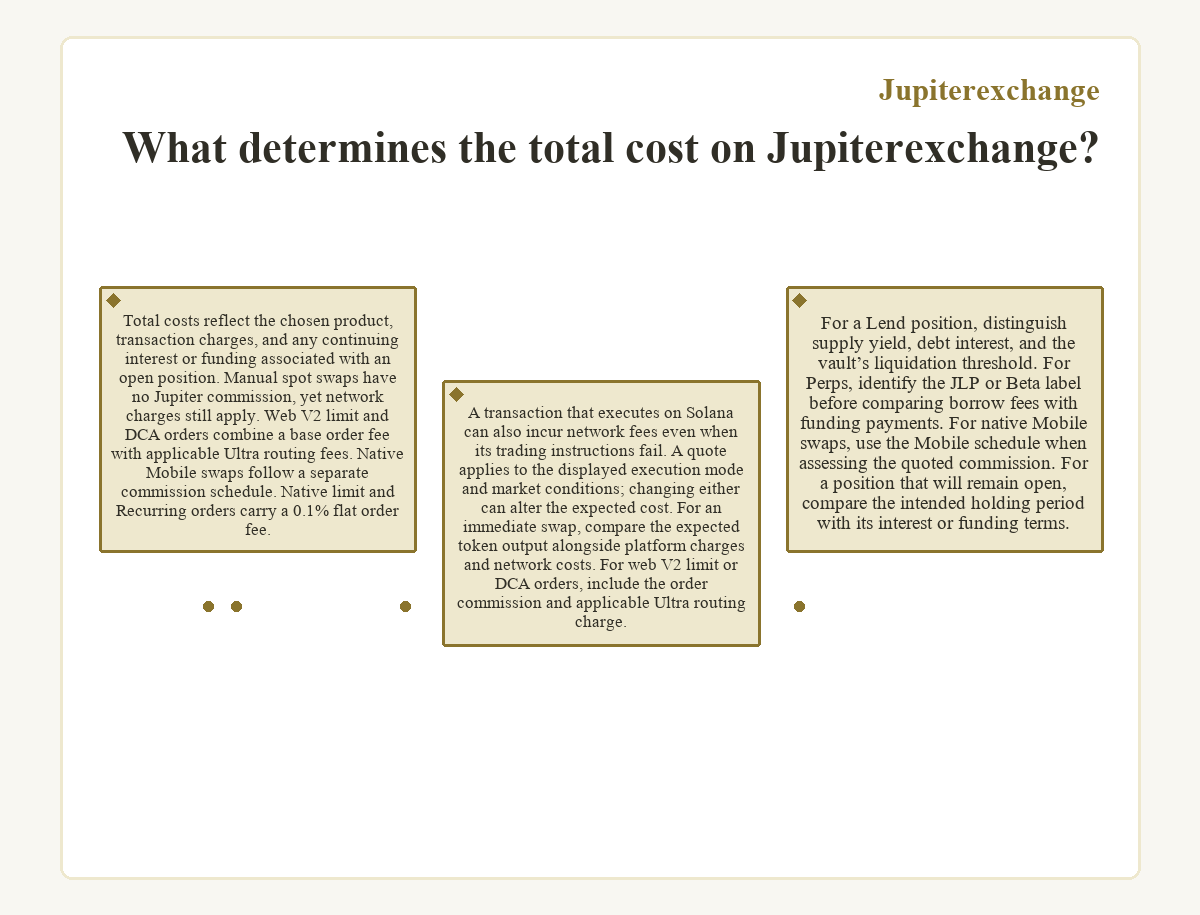
A quote applies to the displayed execution mode and market conditions; changing either can alter the expected cost.
- For an immediate swap, compare the expected token output alongside platform charges and network costs.
- For web V2 limit or DCA orders, include the order commission and applicable Ultra routing charge.
- For a Lend position, distinguish supply yield, debt interest, and the vault’s liquidation threshold.
- For Perps, identify the JLP or Beta label before comparing borrow fees with funding payments.
- For native Mobile swaps, use the Mobile schedule when assessing the quoted commission.
For a position that will remain open, compare the intended holding period with its interest or funding terms.
Still wondering about Jupiterexchange?
-
Can a gasless swap still affect the amount that I receive?
- Ultra Gasless Support recovers the network cost that Jupiter pays through an equivalent token deduction in the swap fee. This recovery sits alongside the normal trading fee. JupiterZ swaps use a different mechanism: the market maker covers network and priority fees, but not token-account rent. In the web Ultra interface, the wallet needs enough SOL to create a missing token account for JupiterZ. In Swap API V2, Jupiter can sponsor output-account rent when referral fees are absent; with referral fees, the wallet must cover that rent in SOL.
-
Does holding JUP give me the fee income that JLP earns?
- Holding JUP does not entitle you to JLP’s pool income or a direct share of protocol fees. JUP supports governance, while JLP represents ownership in the liquidity pool that backs specified perpetual markets. Protocol purchases of JUP are a separate mechanism from distributing fees directly to token holders.
-
Can a DCA or Recurring order be paused and resumed?
- Jupiter’s DCA and Recurring orders do not support pausing and resuming. Stopping requires cancellation; continuing later requires a new order. The new order follows its own schedule and market conditions, rather than preserving the original order as a paused instruction.
-
What can cause a swap to show "no routes found"?
- "No routes found" can indicate insufficient liquidity, a trade amount outside executable size limits, or token trading restrictions. The message does not identify one universal cause. A suggested smaller amount reflects available routing estimates; it does not establish a guaranteed maximum or ensure that a later swap will execute.
-
Is a recovery phrase required for Jupiter ID?
- Jupiter ID uses embedded Quick Accounts that do not generate a recovery phrase. The account instead has an exportable private key. Key export happens through the web interface, rather than inside Jupiter Mobile. Possession of that key gives control over the wallet, so its storage affects the security of the funds.
-
Are the same perpetual markets available on the web and in Jupiter Mobile?
- Jupiter Mobile offers the SOL, ETH, and wBTC JLP-backed perpetual markets, while Beta markets are available through the web interface. The app does not currently offer those Beta markets.